 TideTone
ILLUSTRATED FIELD GUIDE
Write your first handpan melody
Writing a handpan melody is easier when pitch and time are treated as separate choices. Begin with a bar you can hear completely, then make only one change at a time. TideTone lets you inspect a phrase on iPhone or iPad in position numbers, jianpu, or pitch names, so you can use the representation that exposes the next problem.
Together or one after another: hear a chord
Start together
Start in sequence
Compare the same pitches
D3, F4 and A4 contain D, F and A: a D minor triad spread across octaves. Starting together and starting one after another are different presentations of the same pitch collection.
A chord unfolded
Playing chord tones in succession is a broken chord. Resonance may overlap even when attacks do not. Lines in the diagram show attack order, not the length of the sound waves.
Three notes with two hands?
Do not force a three-note strike. Start with a comfortable pair, then add the third in sequence. You can arrange simultaneous attacks in the app to compare; the diagram is not a physical technique instruction.
What if it sounds crowded?
Reduce the number of overlapping notes, lighten the touch or increase the space between attacks. Listen for the line you want to hear. Two notes can be enough for an idea.
Theory background: Open Music Theory
01Make one complete bar
Listen to D3, A3, F4, A3 below before worrying about note symbols. Hear it a few times, then hum or tap the four attacks. Use a straight 4/4 grid when you want to keep it. A quarter note is one beat here; 60 BPM is an example tempo, not a target. [3]
Build two bars from three notes
A · The starting phrase
A · The starting phrase
B · Leave space, change the ending
B · Leave space, change the ending
Listen to A → B
A: D3 → A3 → F4 → A3. B: D3 → A3 → rest → F4. Both bars contain four quarter-note beats. The rest in B is intentional; count beat 3 without striking.
Original teaching example · 60 BPM · no count-in. Natural resonance may continue across a rest; a rest means no new strike.
02Shape the answer
Play the first two notes as a small question and let F4, A3 answer it. If you want a lighter variation, use D3, A3, rest, F4 with quarter-note values. The rest is part of the melody because it gives the next strike a place to land.
03Select the clearest notation
Use pitch names when choosing or checking D3, A3, and F4. If you prefer jianpu, check the displayed reference, here 1=F before interpreting the numbers; the same digit is only meaningful in that context. Position numbers can support practice on a chosen layout, but do not transfer them blindly between instruments. [1]
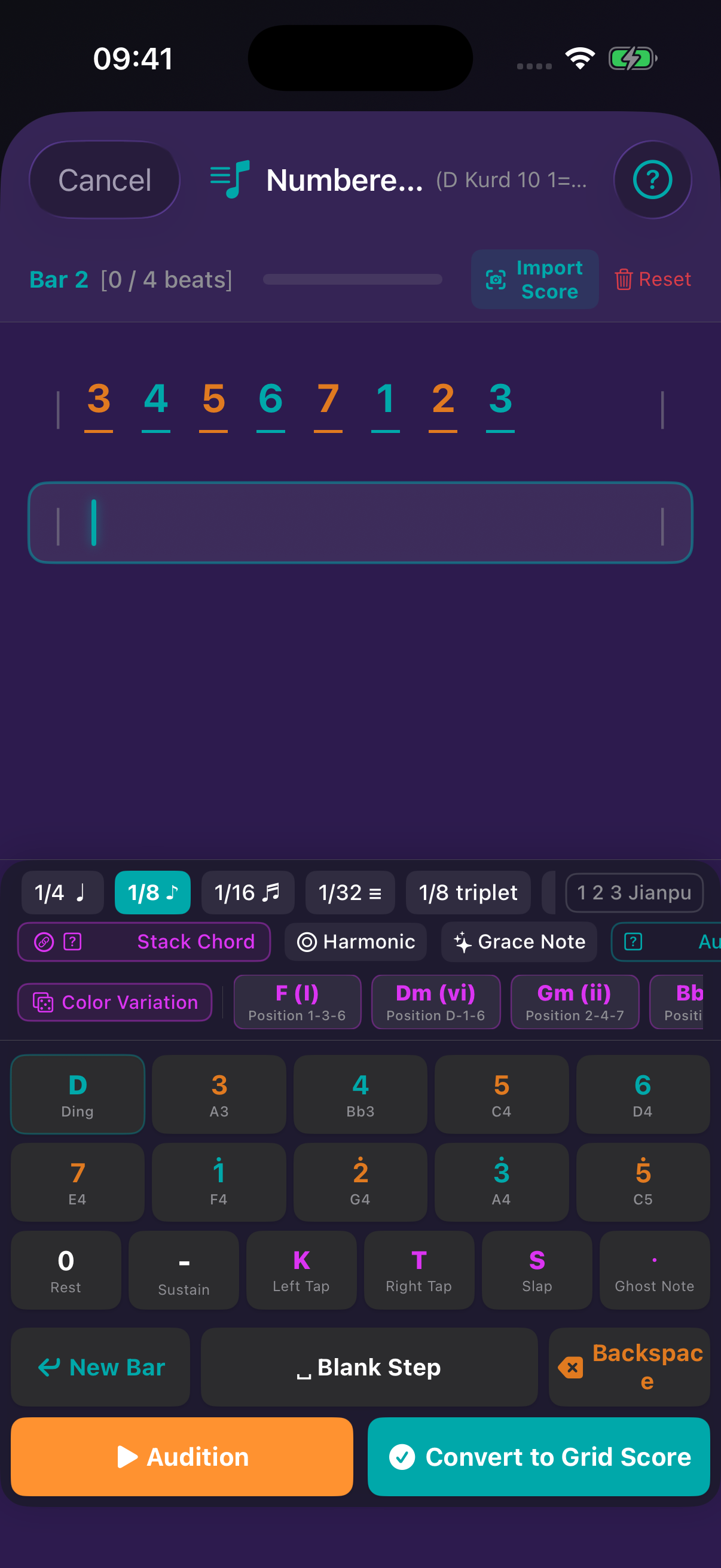
Inside TideTone
Existing TideTone editor screenshot. This shows where to enter and audition notes; it is not a capture of the teaching phrase above.
View full-size screenshot ↗04Revise with your ears
Audition the bar after changing a note, a duration, or a rest. Count four beats while listening, then compare the attack points with your intention. If one note arrives too early, correct its duration before changing pitch; otherwise you may hide a rhythm problem under a prettier note choice.
05Use tools as checks
An optional AI suggestion can provide a starting idea, but treat it as a draft and verify every pitch, rest, and duration yourself. Your self-check is simple: one bar equals four beats, the intended phrase reads D3–A3–F4–A3 or its stated variation, and the audition matches your counted pulse. It cannot guarantee the result will fit every handpan's physical layout or timbre.
Hear A and B, then keep two bars in TideTone
D3
Cell 1
A3
Cell 5
F4
Cell 9
A3
Cell 13
D3
Cell 1
A3
Cell 5
No strike
Cell 9
F4
Cell 13
Listen to A and B above before entering anything. Hum or tap just the attacks: A has four, B has three. Once you can hear the space on beat three of B, use the grid to keep the idea.
- Make A: create an empty exercise, select D Kurd 10, straight 4/4 and pitch-name view. On one track, select cells 1, 5, 9 and 13 and tap D3, A3, F4 and A3 on the virtual handpan.
- Check by listening: play A while counting four beats. If all four notes crowd into beat one, check cell locations before changing tempo.
- Make B: use the actual demonstration linked below to learn bar duplication. Keep A unchanged. In B, delete F4 on beat three and replace the final A3 with F4. Keep the other attack locations and BPM.
- Hear A → B: play both bars and compare the space and ending. You need not enter notes and play your physical instrument at the same time. A version you want to hear again is worth saving.
- Save and check: give it a recognisable name, reopen from the library, check two bars, pitches and BPM, and listen again.
A useful result: hear seven attacks across eight beats and point out that B has no new note on beat three and F4 on beat four. This is a creative choice, not a composition exam.
The grid locates when to attack and which pitch to use without requiring you to memorise every note shape first. To match the quarter-note notation above or export formal notation, also check note values and rests; blank cells alone do not specify extensions or rests. The app does not assess physical striking accuracy.
Actual recording: select a cell, then a tone field · Actual recording: duplicate and edit a phrase · Save and reopen
Try the edit yourself
Keep bar A unchanged. In bar B, enter a quarter rest on beat 3 and F4 on beat 4. Audition both bars at 60 BPM. You should hear seven strikes across eight beats, with no new strike on beat 7.
When something does not match
I cannot remember an idea long enough to enter it
Make a short voice memo first, then transcribe one bar at a time. This is a manual workflow; it does not imply audio-to-score transcription in TideTone.
My second bar sounds like an unrelated tune
Keep bar A as your reference. In B change only the third event to a rest and the final note to F4, as illustrated; compare the ending before adding anything else.
Playback is fine, but I cannot play it
Use one pitch to practise the rhythm first. Reintroduce pitch changes when timing is stable. Correct app playback does not measure your hand technique.
When is this exercise finished?
You can count both bars without losing beat 3 in B, hear seven attacks across eight beats, and find the saved phrase again. Give it a recognisable title before moving on.
Sources & scope
- Major Scales, Scale Degrees, and Key SignaturesChelsey Hamm & Bryn Hughes · Open Music Theory
Background: scale degrees depend on a reference scale, not a handpan position.
- Notating RhythmMark Gotham, Chelsey Hamm & Bryn Hughes · Open Music Theory
Background: notes and rests carry duration.
- Simple Meter and Time SignaturesMark Gotham, Chelsey Hamm & Kris Shaffer · Open Music Theory
Background: reading the beat unit and beats per bar.
The textbook references below support the general music-theory explanations. The diagrams and phrases are original TideTone teaching examples, not copied textbook illustrations. The notation mapping was checked against the current TideTone project (version setting 1.3.1); store releases may differ. These sources do not endorse TideTone.
Found an error? Contact tidetoneapp@gmail.com