 TideTone
Import images and PDFs in TideTone: check, correct and listen
Follow a real bar-line recognition error: compare the source, split a bar, listen, convert to grid and save. Understand ordinary notation versus PDFs containing original score data.
1. Start with two bars
Recognition can reduce manual entry, but a successful result does not guarantee correct pitches, timing or bar lines. Start with a short phrase you can check and hear. You need not understand every symbol to compare a few clear digits and bar lines.
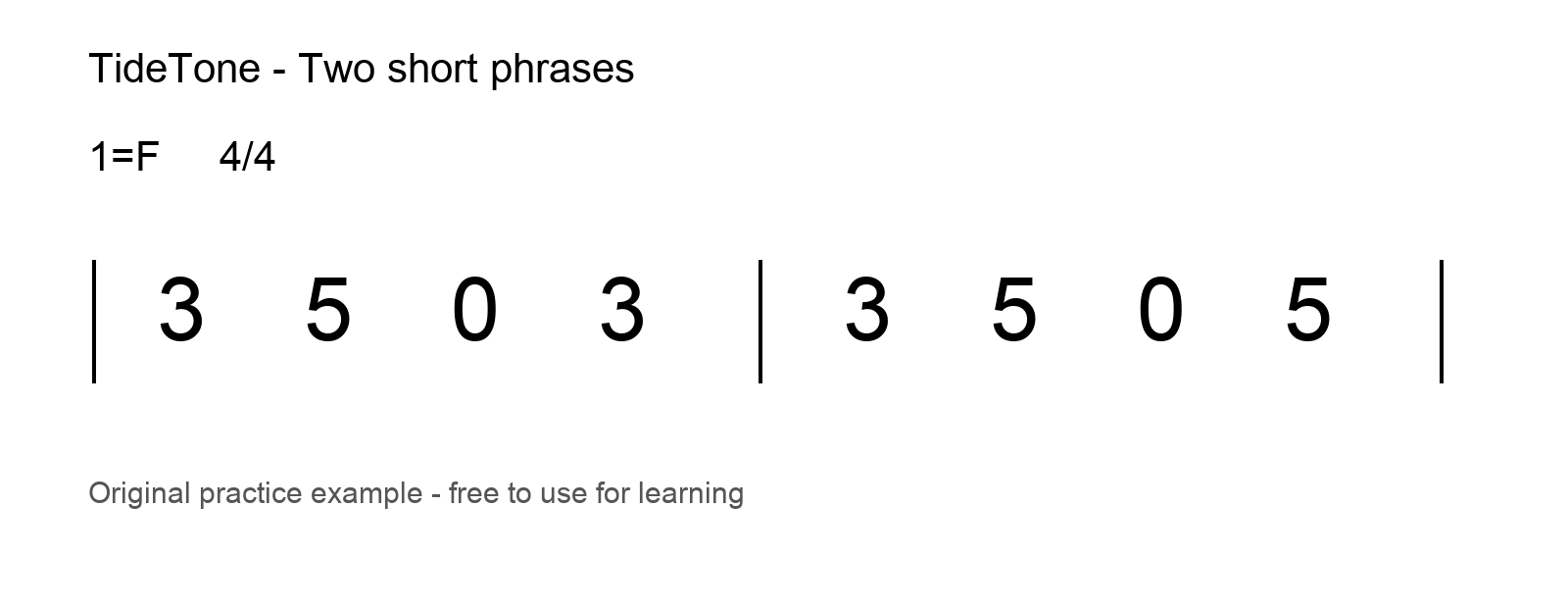
Use D Kurd 10 with 1=F: Jianpu 3 is A3 and 5 is C4. The first bar is A3, C4, rest, A3; the second ends on C4 instead. These digits are Jianpu degrees, not position numbers.
2. Choose the source and review the result
- Save existing work and start a separate empty exercise. Check D Kurd 10 and 4/4.
- Tap the camera icon in the composition toolbar to open Import Score.
- For an image, choose numbered-notation recognition and select a clear printed score from Photos. For PDF, choose PDF recognition and select a file.
- Compare the result with the source before converting. Check warnings, meter, bar count, digits and durations.
See the actual import screen
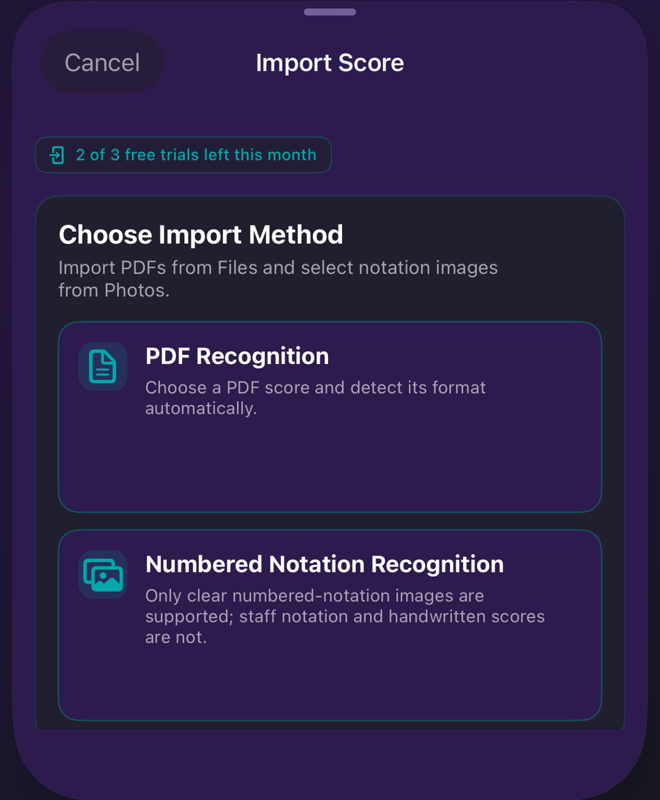
Local processing and membership allowance are separate. Current recognition runs on the device; non-Pro users have three recognitions per month. Check the app for Pro access and remaining allowance. A valid result can count before you save, so repeated imports are not a substitute for checking.
3. A real error: two bars became one
In this test all eight digits were read, but the middle bar line was missed. The app reported one bar and warned that its duration exceeded the meter. The source has two bars. Correct the boundary rather than changing the meter to 8/4 merely to hide the warning.
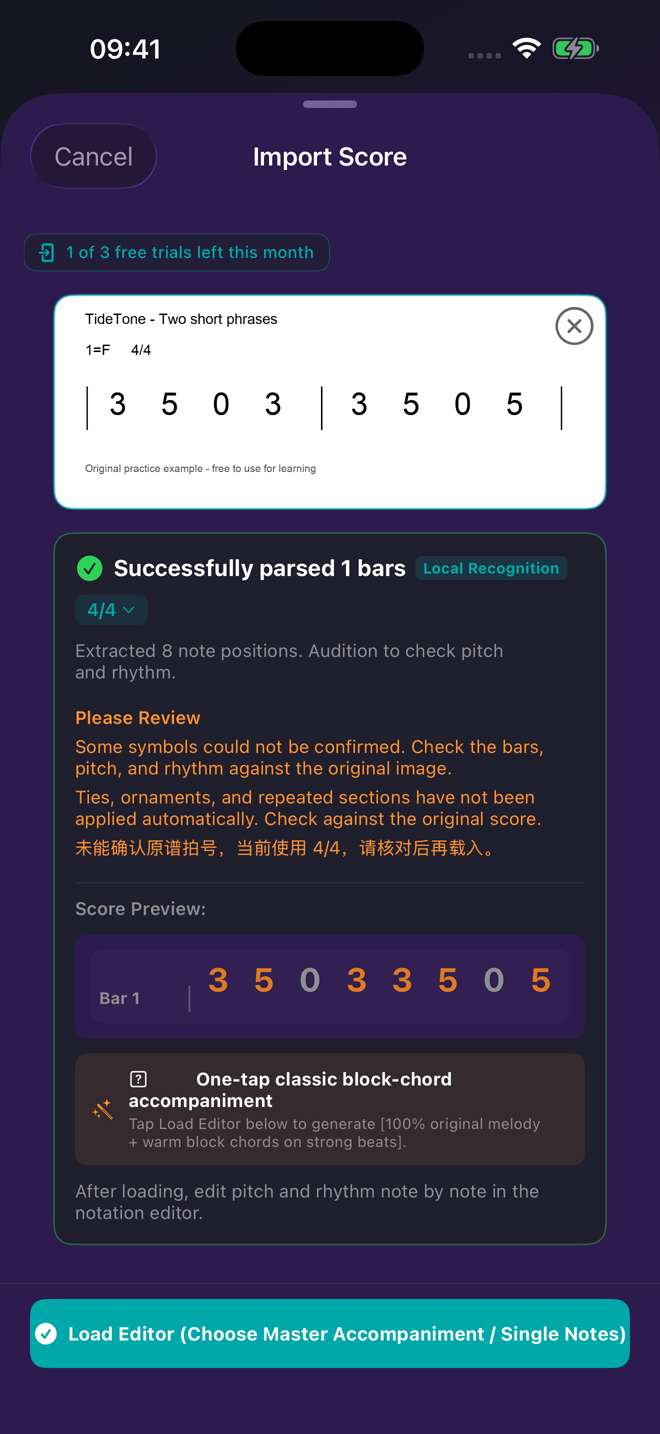
- Count bars: two in the source should remain two.
- Count beats: each bar has four one-beat events, including its rest.
- Check pitches and symbols: compare octave dots, accidentals, duration lines and extensions, not only digits. Ties, ornaments and repeats need particular attention.
4. Split after the fourth event
Yellow circles mark taps. The clip starts after loading the editor. It corrects the bar boundary without generating a different melody. English app interface, tap indicators and native Good Friend audio.
- Load the editor. Its 8/4 capacity indicator means eight beats entered into a four-beat bar, not a change to 8/4 meter.
- Tap the fourth digit, 3, to place the cyan cursor after it.
- Tap New Bar at the lower left. The remaining four events move to a new bar. Check 3 5 0 3 and 3 5 0 5, four beats each.
- Tap Audition and listen first. Beat 3 has no new attack in either phrase; the second ending is higher. Wait for audition to finish before converting; if it is still playing, tap Stop.
The eighth-note tool visible in the clip is the current option for subsequent entry; it does not automatically shorten recognized quarter notes. Do not force every event to an eighth note to remove an overfull warning. Check the source boundaries and durations first.
5. Convert, save and practise
Once audition has finished, tap To Grid and choose Pure Melody to retain the melody without generated accompaniment. Ordinary conversion replaces the current grid, which is why this exercise starts empty. Check for two bars with notes on beats 1, 2 and 4, then replay.
Save, name the piece and reopen it from the library. Listen until familiar, then practise at a comfortable tempo. Importing is the beginning of practice.
Two PDF workflows to distinguish
Ordinary numbered-notation PDF
Choose PDF recognition, review the local result, then load the editor to correct and audition. PDF is only a container; it does not make every score inside reliably recognizable. Check the original for blur, skew, missing pages, ties, ornaments and repeats. Staff notation and handwriting are outside this numbered-notation workflow.
PDF containing TideTone original score data
A compatible TideTone-exported PDF can show an Original Score Preview and restore stored data instead of recognizing an image. Confirming restoration replaces the current composition, including scale, tempo, meter and bars. Save your original, inspect the preview in a blank exercise, then confirm. Not every historical PDF contains this data. Older visual-only TideTone four-track PDFs cannot be re-imported through ordinary numbered-notation recognition.
The earlier recording tests image recognition; the ordinary PDF test below is a separate recording, not universal PDF compatibility. Follow format-specific warnings and mapping review when shown; do not skip unknown symbols or scale checks.
Choose the file, then wait for recognition
Recorded in the real English App on 10 October 2026. System Files and some recognition messages remain Chinese. These separately recorded clips omit recognition waiting; yellow circles show actual taps and other files are hidden. No audition or audio in these clips. Wait for completion before checking the result; the temporary type shown during processing is not the final classification.
Ordinary PDF test: header text can become false notes
We made a one-page ordinary PDF of the same original exercise. This test produced three editor rows: a false header row followed by the two correct melody rows. Check for extra digits that are absent from the music, as well as missing bar lines.
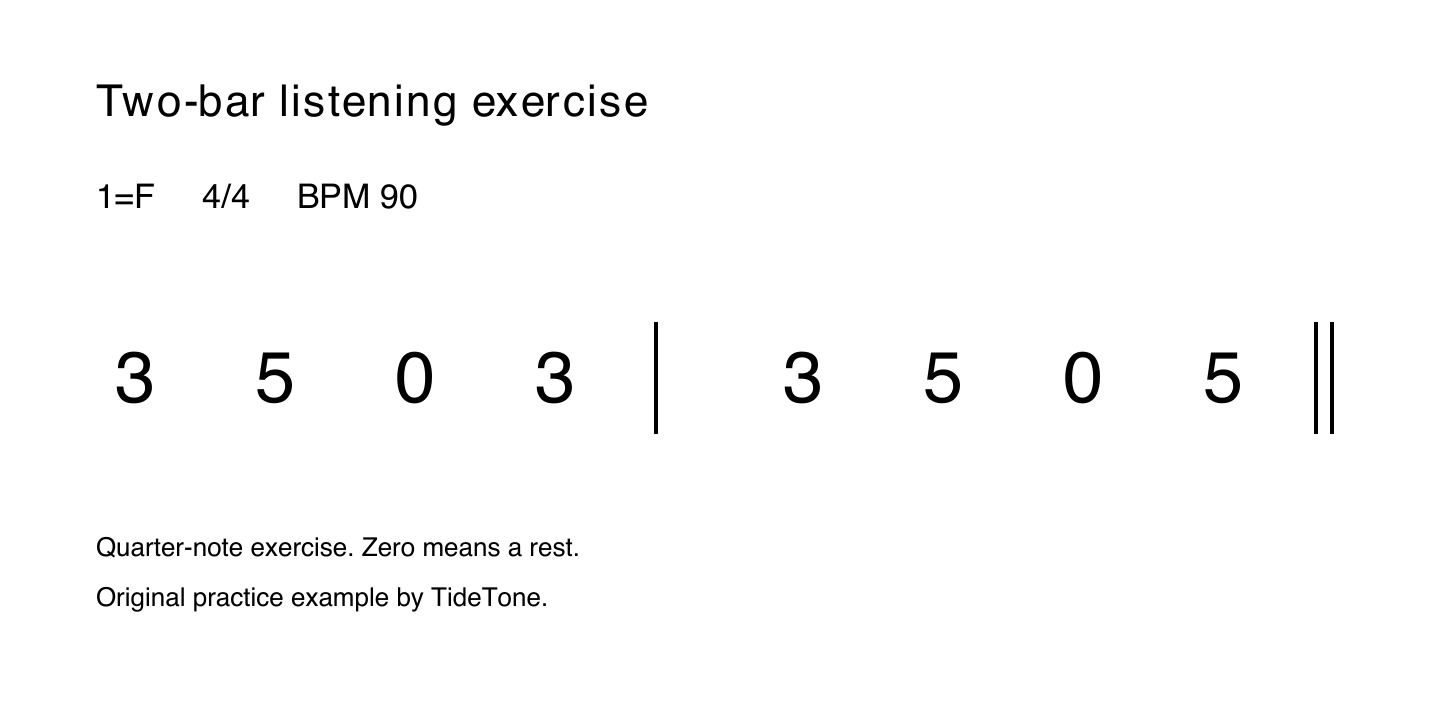
- Compare the original in the local PDF review. This app build reverses the page and bar counts in its summary; the actual file has one page. Do not infer source length from that summary.
- Tap Open Notation Preview. Header text 1=F, 4/4 and BPM90 became extra events. The first row shows 7.50/4, exceeding its four-beat capacity.
- Place the cursor after the false row and delete its eight events. Remove only content you have confirmed is extra. Keep the two melody rows, 3 5 0 3 and 3 5 0 5.
- Audition: neither bar has a new attack on beat 3; the second ends higher. The emptied first row adds no rest duration and is filtered out during this conversion, leaving two grid bars.
This single result does not establish accuracy for other PDFs. Other files may lose notes or misread octaves and durations. Compare every result with its source, especially repeats, ornaments and ties.