 TideTone
ILLUSTRATED FIELD GUIDE
How to Read Handpan Notation: Numbers, Pitch and Rhythm
Identify the notation, match positions to pitches, then count beats and rests. Read one four-note bar with a diagram and audio; numbering varies by layout.
One phrase. Three ways to read it.
| Beat | 1 | 2 | 3 | 4 |
|---|---|---|---|---|
| Position | D | 1 | 6 | 1 |
| Jianpu | 6 | 3 | 1 | 3 |
| Pitch | D3 | A3 | F4 | A3 |
Listen to the example
TideTone D Kurd 10 · 1 = F. Each column is the same sounding note; each event lasts one quarter-note beat. The D in the position row marks the central Ding, not a scale degree. Octave dots follow TideTone’s display convention.
A dot below lowers the register; a dot above raises it. Check the pitch-name row for exact octaves. Position 1 = A3 = jianpu 3 in this layout.
Original teaching example · 60 BPM · no count-in. Natural resonance may continue across a rest; a rest means no new strike.
01Identify positions and scale degrees
Check the score legend and instrument layout first. Position numbers identify tone fields in a particular layout; Jianpu 1–7 identify scale degrees relative to a stated reference. In the table above, TideTone D Kurd 10 position 1 is A3, shown as Jianpu 3 with F3 as reference 1. This mapping is an example, not a numbering standard for every handpan. R/L marks the hand to use, not a pitch. [1]
02Check pitch names and octaves
In A3, A names the pitch class and 3 specifies the octave. Read the pitch-name row as D3, A3, F4, A3. In the Jianpu row, a dot below lowers the register and a dot above raises it; use the pitch names to check the exact octave. D in this position row marks the central Ding, D3. It is neither position 1 nor Jianpu 1.
03Count durations and rests
Check the meter and the score legend before counting. Here 4/4 uses a quarter-note beat and each table column lasts one beat. In the Jianpu convention used here, an underline halves a note value, a following dash extends it, and 0 is a rest. A dot to the right adds half the original duration; it is different from an octave dot. Do not transfer these conventions to an unfamiliar position score without checking its legend. Count through rests without a new strike; earlier resonance may continue. [2] [3]
04Read the four-note example in order
Count 1, 2, 3, 4 while following D3 → A3 → F4 → A3. There is one new attack on each beat: four attacks in one complete bar. Listen to the existing 60 BPM example and compare each column with its position and Jianpu labels. There is no count-in. Do not confuse a ringing tail with another written note or assume that four symbols always mean four beats.
05Match the score to your own instrument
Compare actual pitch names and octaves with the maker’s pitch list. Position 1 on a different handpan need not be A3. If the required pitch is missing, choose a compatible phrase or adapt it deliberately; changing a number alone does not preserve the melody. The D Kurd 10 example does not limit which other scales you can read or use in TideTone.
Listen to five free scores; choose a short phrase → · Practise a selected phrase with a loop →
Check your understanding
In this D Kurd layout, does position 1 mean jianpu 1?
No. Position 1 is A3, displayed as jianpu 3. The same number in different notation systems can describe different things.
When something does not match
The same number sounds different
Check whether it denotes a physical position or a scale degree. In this example position 1 is A3, while jianpu 1 refers to F. Switch to pitch names to compare exact pitches.
The melody is an octave too high
Compare the octave dots and the pitch-name row. Correct the register before changing the rhythm.
The notes fit, but the phrase finishes early
Count durations, including rests. Four symbols are not necessarily four beats; the example uses four quarter-note events.
My handpan has a different layout
Match actual pitch names, not position numbers. If a pitch is absent, transpose or adapt deliberately and check the whole phrase; changing only a position number is not a reliable conversion.
Optional: compare displays in TideTone
The reading example above works without the app. These existing recordings show a different phrase and demonstrate display switching, not a new reading rule.
No re-entry or scale change is needed. The phrase stays A3, C4, A3 on beats 1, 2 and 4. Use the same lower-right display toggle, then replay. Start with whichever display makes sense to you.
Press play for sound. Yellow indicators mark the toggle and playback controls. All three replays use 60 BPM with the same attack positions. English app UI and captions, using authentic 好朋友 handpan audio.
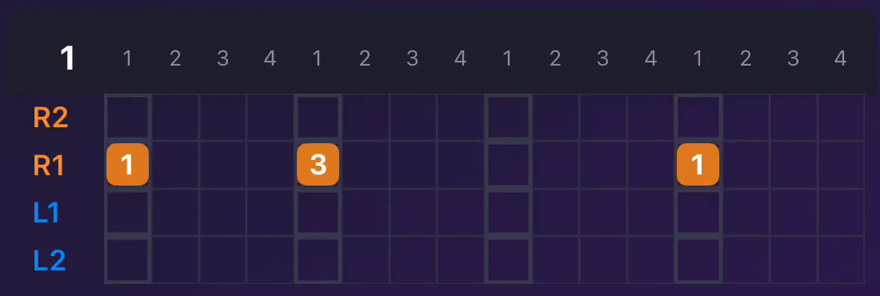
Numbers identify tone fields in the current layout: position 1 is A3 and position 3 is C4 here.
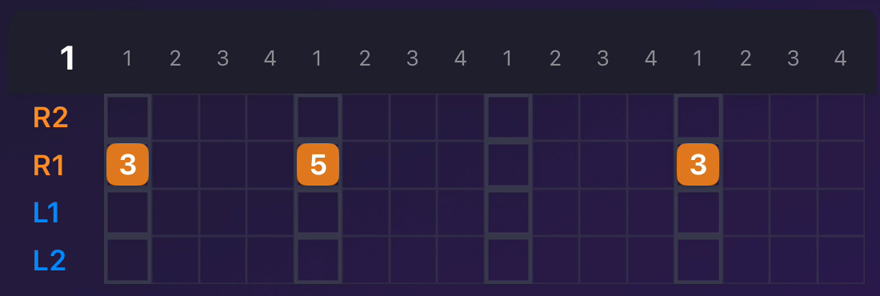
Numbers express relative degrees. TideTone’s D Kurd 10 uses 1=F: A3 is 3 and C4 is 5 in this example.
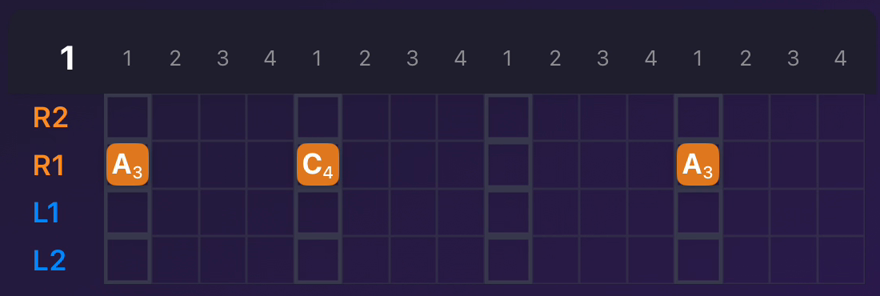
The letter and octave number identify the pitch, useful for checking a physical handpan or piano key.
Two different meanings of “1”
Position 1 is A3, not Jianpu do. The reference here is F3=1, even though F3 is absent from D Kurd 10. A reference need not be an available tone or the central Ding. Ding D3 is a low 6 with a dot below; F4 is a high 1 with a dot above, and A4 a high 3. Those dots matter.
Changing display does not change pitch, rhythm or composition content. This remains the grid; it does not open the Jianpu editor. Check other scores’ references and numbering rules rather than applying this mapping to every handpan.
Quick check: does position 3 stay 3 in Jianpu?
No. Position 3 is C4 here, displayed as Jianpu 5. It still sounds C4.
Sources & scope
- Major Scales, Scale Degrees, and Key SignaturesChelsey Hamm & Bryn Hughes · Open Music Theory
Background: scale degrees depend on a reference scale, not a handpan position.
- Notating RhythmMark Gotham, Chelsey Hamm & Bryn Hughes · Open Music Theory
Background: notes and rests carry duration.
- Simple Meter and Time SignaturesMark Gotham, Chelsey Hamm & Kris Shaffer · Open Music Theory
Background: reading the beat unit and beats per bar.
The textbook references below support the general music-theory explanations. The diagrams and phrases are original TideTone teaching examples, not copied textbook illustrations. The notation mapping was checked against the current TideTone project (version setting 1.3.1); store releases may differ. These sources do not endorse TideTone.
Found an error? Contact tidetoneapp@gmail.com