D Kurd 10
10 pitches, D3–C5. Fewer positions to locate while following our starter exercises. This does not limit you to simple music.
 TideTone
Connect app positions, pitch names and Jianpu numbers. One sound can have three labels. You only need to find one note to begin.
If you own a handpan, start with the configuration that matches its actual pitch list, not just its name. Without an instrument, D Kurd 10 matches our first-phrase exercise using A3 and C4. You can also explore E Amara 20: try two or three notes without memorizing all twenty.
10 pitches, D3–C5. Fewer positions to locate while following our starter exercises. This does not limit you to simple music.
20 pitches, C3–A5, including outer extended notes. More registers to explore, but this is not D Kurd plus ten notes: the pitch set and positions differ.
More notes do not automatically mean a better choice. Try a few sounds, listen to how they connect, and consider your instrument, the music you want to play and how comfortably you can find the notes.
D Kurd 10:position 3 · Jianpu 5 = C4
E Amara 20:position 15 · Jianpu 4 = C4
The pitch identity C4 stays the same. Its location and notation reference change. Sound packs may sound different, so this compares pitch and position, not the quality of physical handpan materials.
Press play for app audio; yellow circles mark taps. A separate empty exercise is used, without changing an existing score. Chinese interface with English captions.
This recording of the interactive diagrams below highlights the same C4 in purple, first on D Kurd, then E Amara. This position-only clip is silent. To hear the notes, enable sound below and try the diagrams yourself. Labels in the recording are Chinese.
Why can’t I switch with notes present? The current app blocks a different scale when notes are present and asks for notes to be cleared. This is a restriction, not automatic transposition. Do not clear a piece you want to keep just to experiment; save it and start a separate empty exercise.
When a note is missing, check its octave first. Then choose another exercise or deliberately adapt the phrase and listen again. Substituting a pitch makes a new musical choice; it does not preserve the original unchanged.
Enable sound below and locate C4 in each diagram · Enter your first phrase in the grid
Hover or tap a note to link both diagrams. Enable sound to listen. Tab selects a note; Enter plays it. Uses existing website samples; missing pitches use shifted samples as pitch references, not original tone-field timbres.
Playback uses existing website samples. Some pitches are shifted references, not the original timbre of the corresponding tone field.
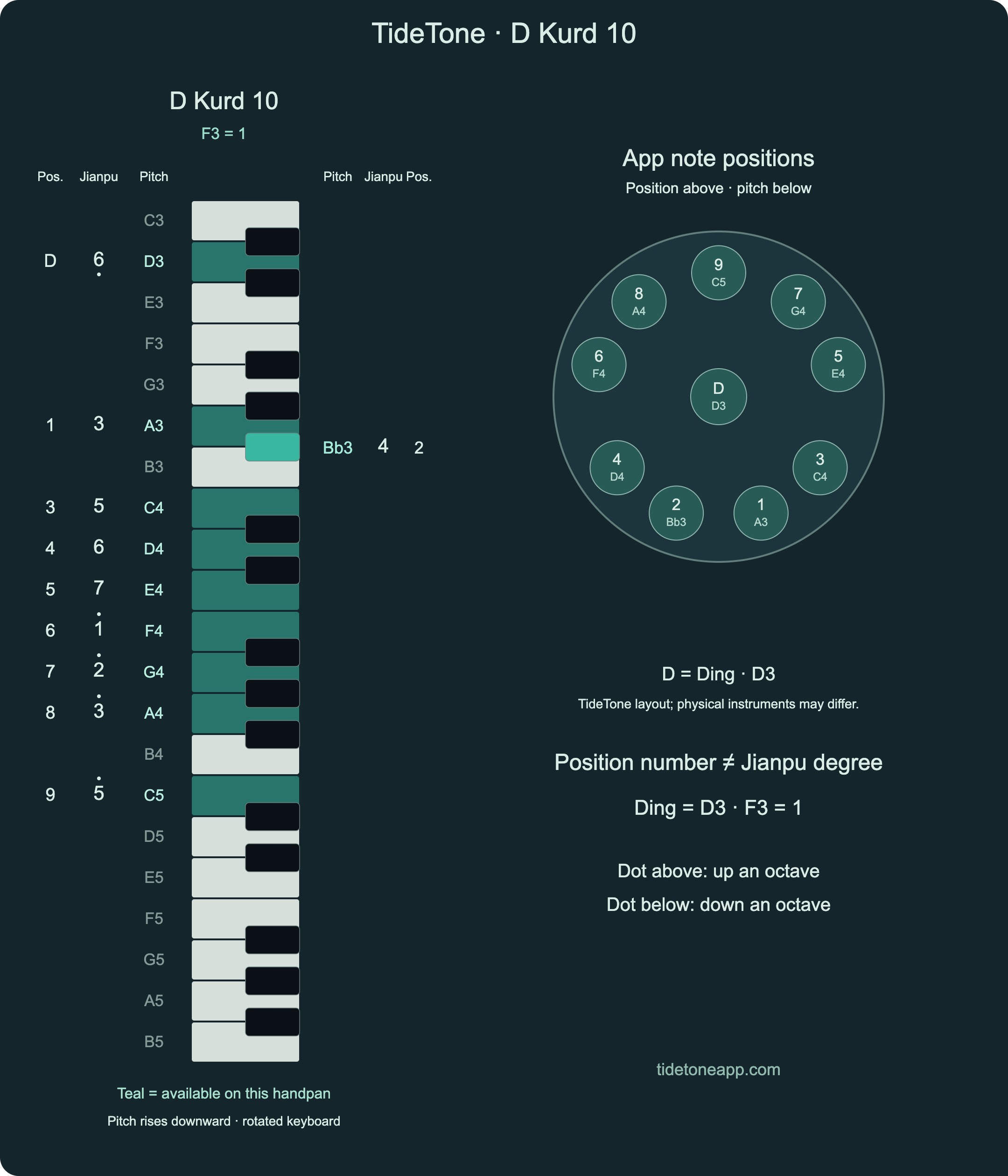
A position number identifies an area in the current app layout. A pitch name identifies a sound, such as A3. Jianpu is numbered relative to a chosen 1. On D Kurd, position 1 plays A3, written as Jianpu 3. Position 1 and Jianpu 1 are different labels.
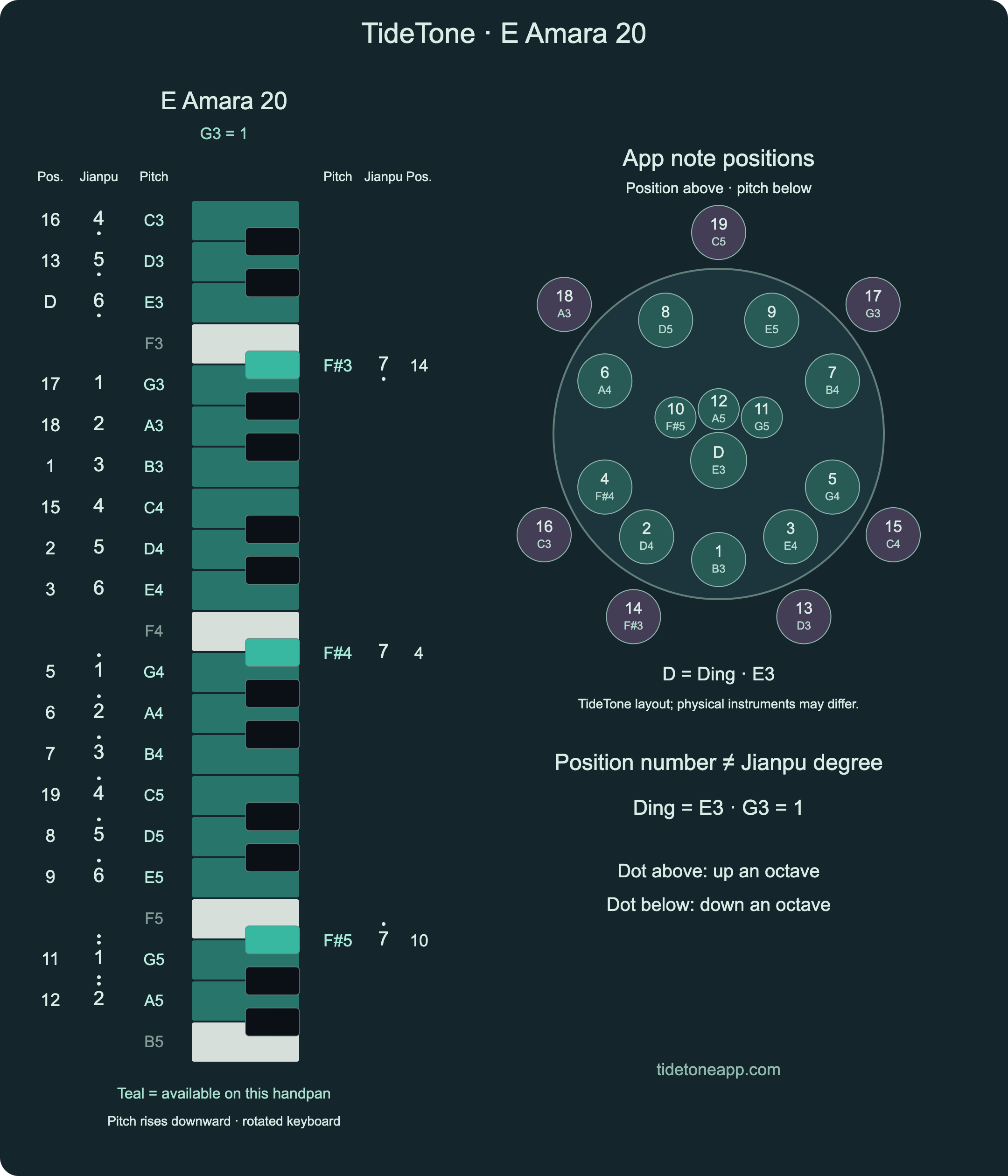
These diagrams follow TideTone’s notation reference: undotted 1 is F3 for D Kurd, and G3 for E Amara. This does not change the central note. D Kurd’s Ding is D3; E Amara’s Ding is E3. Both are written as 6 with one dot below in their respective references. F3 is a notation reference, not an available note on this D Kurd.
One dot above a Jianpu digit means one octave above its undotted version; one below means one octave below. Two above mean two octaves up. In A3 and A4, the final number identifies the octave of the named pitch. Do not confuse this octave number with an app position or a Jianpu digit.
Download the complete chart (PNG) · SVG
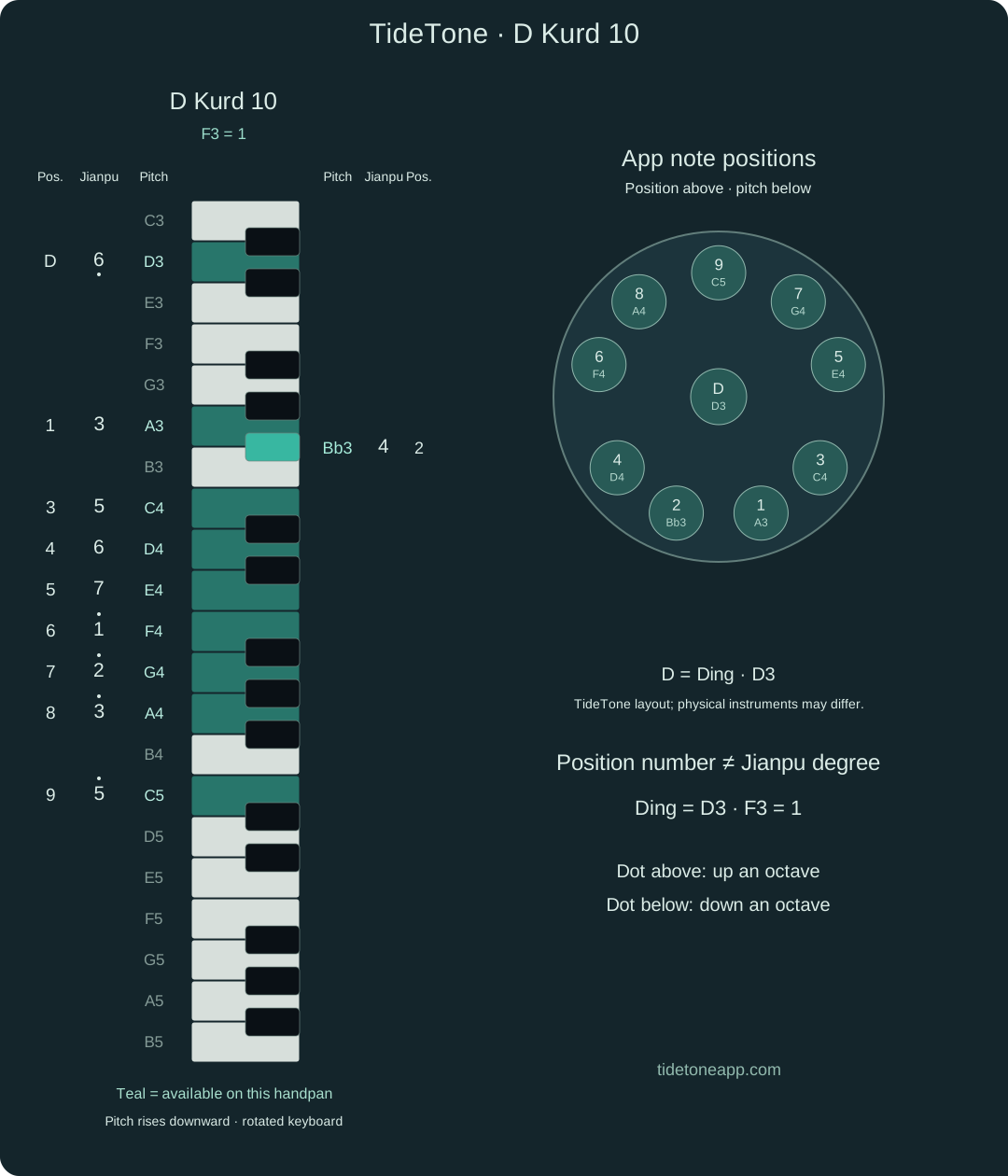
D: D3 · 1: A3 · 2: Bb3 · 3: C4 · 4: D4 · 5: E4 · 6: F4 · 7: G4 · 8: A4 · 9: C5
Download the complete chart (PNG) · SVG
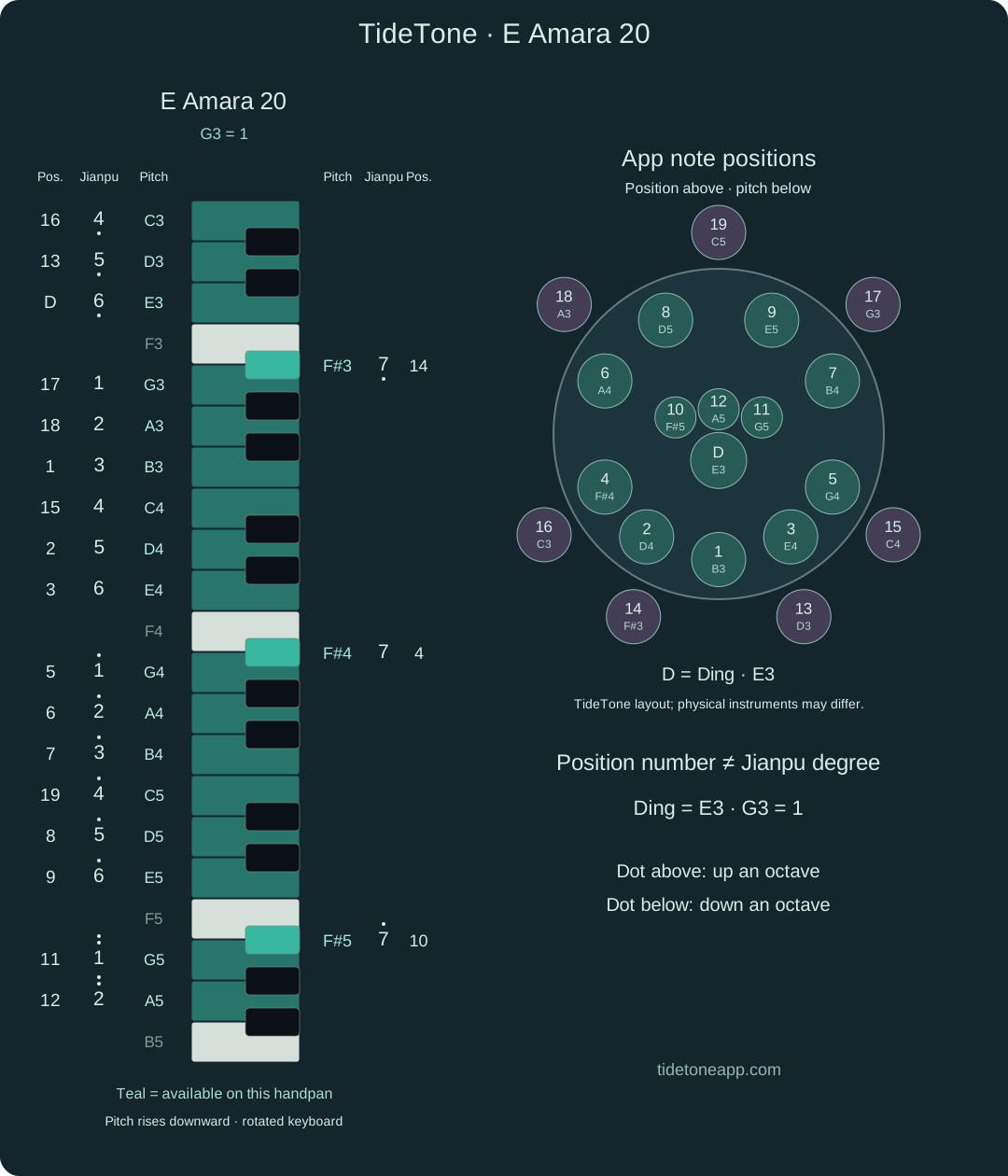
D: E3 · 1: B3 · 2: D4 · 3: E4 · 4: F#4 · 5: G4 · 6: A4 · 7: B4 · 8: D5 · 9: E5 · 10: F#5 · 11: G5 · 12: A5 · 13: D3 · 14: F#3 · 15: C4 · 16: C3 · 17: G3 · 18: A3 · 19: C5
No. They are part of the keyboard layout. D Kurd uses Bb3: B lowered by a semitone. E Amara uses F#3, F#4 and F#5: F raised by a semitone in each octave. With these notation references, Bb is degree 4 and F# is degree 7; they do not need an extra accidental each time. Unhighlighted keys are absent from the selected handpan.
On D Kurd, find position 1 (A3), position 2 (Bb3), then position 6 (F4). Their Jianpu labels are 3, 4 and 1 with one dot above. On E Amara, try position 1 (B3), position 4 (F#4) and position 11 (G5): 3, 7 and 1 with two dots above. Listen slowly; a finished tune is not required.
Positions are not a complete ascending pitch order. E Amara position 13 is D3, 16 is C3 and 19 is C5. The app displays these extended notes around the outside. D stands for Ding, not necessarily the pitch D. Check your maker’s physical layout; the app’s outer ring does not specify which notes are on a physical top shell.
Redrawn from the supplied reference charts and checked against TideTone’s scale, position and notation definitions. These are the app’s configurations, not universal specifications for every similarly named handpan.